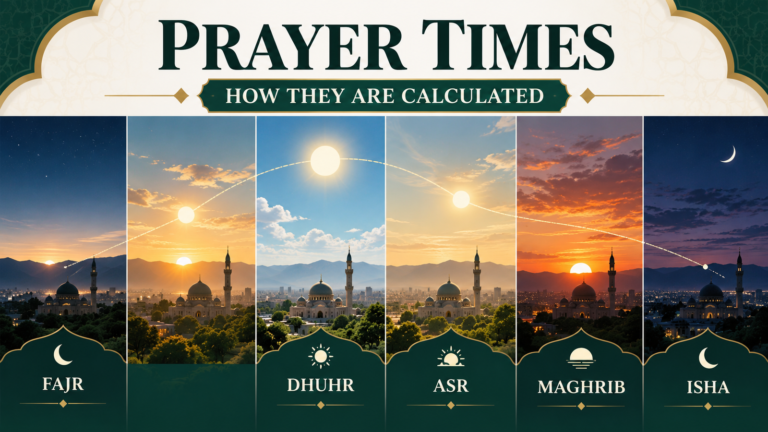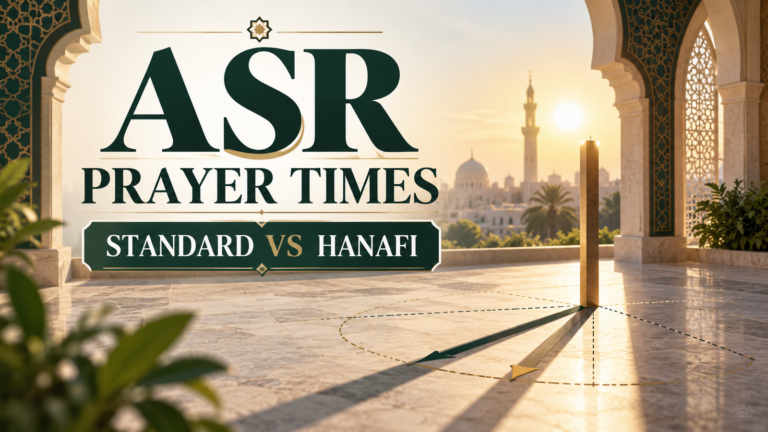
Sehri (Suhoor) ends when true dawn begins, and Iftar begins at sunset. These are the Qur’anic boundaries of the daily fast. In a timetable using the standard Sunni convention, the Sehri cutoff aligns with the calculated start of Fajr, while Iftar aligns with the separately calculated sunset event.
This guide explains the sources, why sunrise is too late to stop eating, what an “Imsak” entry means, and why a prayer app may differ slightly from your local mosque’s published calendar.
The Qur’anic rule: from dawn to nightfall
Surah Al-Baqarah 2:187 permits eating and drinking until the dawn boundary becomes clear and then directs completion of the fast until night. The verse is the primary reference for when a day’s fasting restrictions begin and end.
It is important not to mistake “dawn” for “sunrise.” Dawn occurs earlier. Waiting until sunrise to stop eating would not follow the ordinary dawn-based timetable.
What time does Sehri end?
Sehri—also written Saheri, Suhoor or Sahur—is the pre-dawn meal. It is recommended to eat before the daily fasting boundary. The relevant cutoff for food and drink is true dawn (Fajr Sadiq), not the moment when the Sun’s disk appears.
Sahih al-Bukhari 1918–1919 reports that an earlier nighttime Adhan did not end the opportunity to eat; the dawn Adhan marked the later boundary. Sahih Muslim 1093b helps distinguish the true dawn relevant to fasting from false dawn.
Our monthly fasting timetable should therefore show both “Sehri Ends” and “Fajr” explicitly, even though the values are generated from the same calculated instant. The duplicate time is intentional: each label answers a different reader question.
Is it compulsory to stop 10 or 15 minutes before Fajr?
Some printed calendars include “Imsak,” often a precautionary reminder earlier than the calculated Fajr time. Such a reminder should not be presented as a second, universally prescribed dawn boundary. Qur’an 2:187 establishes true dawn as the religious cutoff.
A household may choose to finish a meal earlier for practical reasons, but a website must label an early alert as an optional reminder. It should not say fasting becomes compulsory at an invented fixed 10-minute or 15-minute offset.
What does the Hadith about fifty verses mean?
In Sahih al-Bukhari 1921, Zaid ibn Thabit describes an interval between Suhoor and the prayer/Adhan in terms of the time needed to recite fifty Qur’anic verses. It gives a picture of the Prophet’s practice; it does not supply a universal clock-minute formula that overrules the dawn boundary stated in the Qur’an.
Sahih al-Bukhari 1923 also encourages Suhoor because of its blessing. The report does not make eating a particular meal a prerequisite for the validity of the fast.
When does Iftar begin?
Iftar begins at sunset. Sahih al-Bukhari 1954 connects breaking the fast with sunset and the retreat of daylight. Sahih al-Bukhari 1956 illustrates that there is no requirement to wait until the sky becomes completely dark after sunset.
When our plugin displays both “Maghrib” and “Iftar,” the Iftar value must come from the explicit sunset calculation. That distinction matters because some prayer-time profiles may apply a display adjustment to Maghrib. A prayer label should not accidentally change the sunset-based fasting boundary.
Sehri and Iftar example: how to read a city timetable
Suppose a verified daily calendar for a city shows Fajr at 5:40 AM and sunset at 6:15 PM. In that illustrative case, the Sehri cutoff is 5:40 AM and Iftar begins at 6:15 PM. These are invented teaching values, not actual prayer times for your city on a given date.
| Timetable label | What it means |
|---|---|
| Sehri Ends | Calculated true-dawn boundary / Fajr starts |
| Sunrise | Later solar event; not the fasting-start boundary |
| Maghrib | Prayer-time label under the selected method |
| Iftar | Sunset, using the separate solar event |
What if my mosque has a different published time?
Local mosques may adopt different twilight angles, local observational adjustments and rounding practices. A calculated timetable should state its location, time zone and method so readers can make informed comparisons. In cases of uncertainty, consult a reliable local religious authority rather than making assumptions based on a neighboring city’s timetable.
To see configured times, visit the Ramadan and Fasting hub. Our explanation of differing timetables can help you compare calculation settings.
Frequently asked questions
Can I eat after the Fajr time shown on the timetable?
The religious fasting boundary is true dawn. If the timetable accurately reflects the dawn convention you follow, it should not be treated as permission to eat later. Consult qualified local guidance where actual calculation uncertainty exists.
Must I wait after the Maghrib Adhan to break the fast?
The standard sunset-based boundary does not require waiting for darkness once sunset is established. If your local timetable or mosque follows an alternative convention, clarify its basis with that authority.
Does an earlier Imsak alert change the start of Fajr?
No. A reminder may assist meal planning but it is not an additional compulsory prayer or fasting boundary.