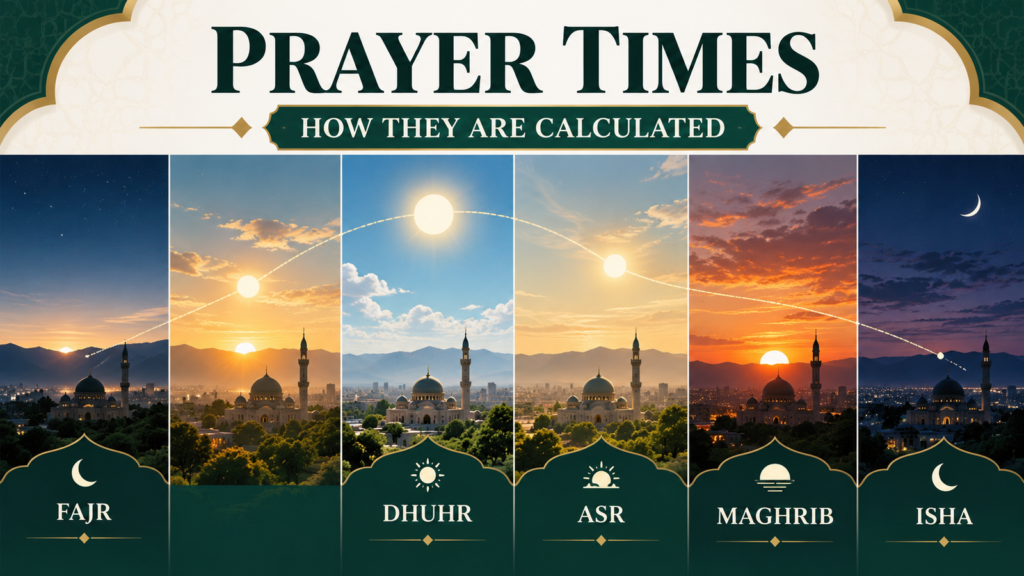
Islamic prayer times are determined by natural signs connected to the Sun. Modern prayer calendars turn those signs into local clock times using astronomy, geographical coordinates and documented calculation conventions. The Qur’an establishes appointed prayer times; authentic Hadith explain the relevant boundaries. Calculators estimate when those boundaries occur for each city and date.
This distinction matters: the religious sources establish the signs, while a modern calculation method estimates their clock times. Neither a fixed Fajr offset before sunrise nor a universal set of clock hours would work throughout the year.
What the Qur’an and Hadith establish
Qur’an 4:103 describes prayer as an obligation at appointed times. Qur’an 17:78 refers to the Sun’s decline, the darkness of night and the dawn recitation. More detailed boundaries appear in Sahih Muslim 612b and in the account of Jibreel demonstrating prayer times, Sunan Abi Dawud 393.
These texts identify astronomical events rather than naming modern clock hours. They also leave room for recognized jurisprudential interpretations, including differences in the start of Asr and particular twilight boundaries.
The five prayers and their natural signs
| Prayer or event | Natural sign used | What the calculator estimates |
|---|---|---|
| Fajr | True dawn before sunrise | Morning twilight according to the selected convention |
| Sunrise | Appearance of the Sun above the horizon | Sunrise, accounting for standard atmospheric refraction |
| Dhuhr | The Sun passes its highest point | Local solar transit, with any documented adjustment |
| Asr | Lengthening afternoon shadow reaches the specified ratio | Solar altitude corresponding to Standard or Hanafi Asr |
| Maghrib | Sunset, in the standard Sunni convention used here | Sunset, potentially with a stated method adjustment |
| Isha | Relevant evening twilight disappears | Evening twilight angle or a documented interval |
Sunrise is displayed on prayer schedules because it is an important boundary, but it is not a sixth obligatory prayer.
Why Fajr is calculated from twilight, not a fixed offset
Fajr begins at true dawn (Fajr Sadiq), which is earlier than sunrise. Sahih Muslim 1093b distinguishes the dawn relevant to prayer and fasting from an earlier false dawn. The interval between true dawn and sunrise is not identical in every city, season or calculation convention.
Many software methods represent the beginning of Fajr by the Sun reaching a chosen number of degrees below the horizon in the morning. For example, ISNA commonly uses 15° while the Muslim World League method uses 18°. These are calculation conventions and must not be described as degrees specified in the Qur’an or Hadith.
How Dhuhr and Asr calculations work
Dhuhr relates to solar noon: the moment when the Sun crosses the local meridian. Solar noon often differs from 12:00 on a wall clock because of longitude within a time zone, the equation of time and daylight-saving rules.
For Asr, the key observation is an upright object’s afternoon shadow. Modern calculations account for any shadow already present at solar noon. In the Standard convention, the additional afternoon shadow equals the object’s height; in the widely used Hanafi convention, it equals twice the height. This is why two valid timetables may show different Asr starting times. The detailed discussion belongs in our Standard versus Hanafi Asr guide.
How Maghrib and Isha are determined
For the standard Sunni schedule presented on this website, Maghrib begins at sunset. Isha begins after the applicable evening twilight has disappeared. Some calculation methods express Isha as a solar depression angle; others use an interval after sunset. These methods are not interchangeable.
The Hadith provide important distinctions between prayer beginnings, preferred periods and final permissible boundaries. For example, Sahih Muslim 612b discusses the times of the five prayers. A timetable normally presents calculated starting times; it should not imply that each prayer is valid only at the displayed minute.
Why your city and date matter
A useful prayer calculator requires geographical latitude and longitude, the local Gregorian date, a valid IANA time zone and the chosen calculation settings. Latitude affects the Sun’s path; longitude affects local solar transit; and the date determines seasonal changes.
For a city such as Lorton, Virginia, clocks shift between daylight-saving and standard time. A timetable generated ahead of time must apply America/New_York correctly for each date, rather than assuming a single fixed UTC offset for the year.
High-latitude locations introduce another challenge: the relevant twilight may not occur on certain dates. Some timetables use an explicitly labeled high-latitude approximation. A responsible tool should show the selected rule rather than silently invent a normal astronomical event.
How our WordPress prayer-time platform uses these principles
Our Islamic Utilities Core system is designed to calculate daily values from a native PHP astronomical engine and store a rolling schedule. It distinguishes the location, calculation method and Asr convention. Sehri ends at the calculated Fajr boundary; Iftar uses the calculated sunset event.
See the Prayer Times hub to choose an available city, or visit the Fasting hub for Sehri and Iftar information. A city should only be shown publicly after its coordinates, timetable and page are verified.
Questions readers commonly ask
Are 15° and 18° religiously prescribed numbers?
No. They are later astronomical conventions used to estimate when twilight corresponds to religiously defined dawn or nightfall. Authorities differ on which convention best matches local observations.
Why is solar noon not always 12:00 PM?
Clock time follows civil time zones; solar noon depends on longitude and the changing apparent motion of the Sun. Daylight-saving time adds another clock adjustment.
Does an Adhan app give the Iqamah time?
Usually not. A calculated prayer start is different from a mosque’s congregational Iqamah schedule. Check a mosque’s published timetable for Iqamah.