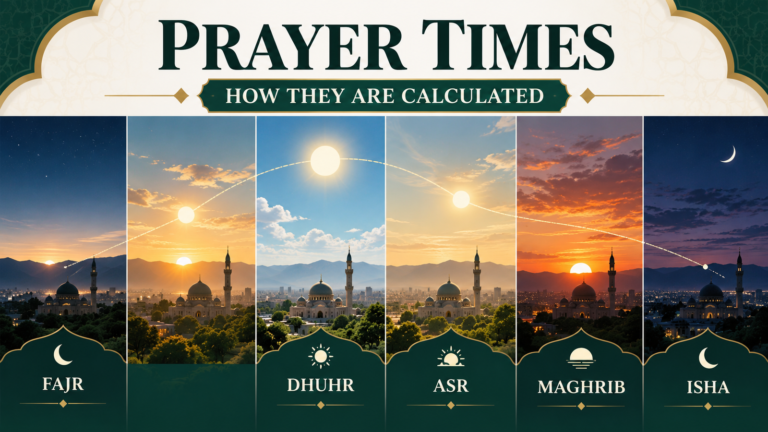
Fajr and sunrise are not the same event. Fajr begins with true dawn, when morning light starts spreading along the eastern horizon. Sunrise occurs later, when the Sun itself begins to appear. This difference matters both for the validity of the Fajr prayer and for the beginning of a daily fast.
The short answer: Fajr starts at true dawn
The Qur’an describes the dawn boundary for fasting in Al-Baqarah 2:187. The chapter heading associated with Sahih Muslim 1093b identifies the second, true dawn as relevant to both the beginning of fasting and the morning prayer. By contrast, Sahih Muslim 612b states that the time for the morning prayer continues until sunrise.
So a correctly labeled prayer calendar shows two different values: Fajr (when the prayer starts) and Sunrise (when its ordinary time ends).
| Question | Answer |
|---|---|
| When does Fajr start? | At true dawn, before sunrise. |
| When does Fajr end? | At sunrise. |
| Does fasting begin at sunrise? | No. It begins at true dawn. |
| Is sunrise itself an obligatory prayer? | No; it is a separate solar event and a boundary on the timetable. |
True dawn and false dawn
Traditional Islamic discussion distinguishes Fajr Kadhِib (false dawn) from Fajr Sadiq (true dawn). False dawn is an earlier appearance of light that does not establish the prayer and fasting boundary. True dawn is associated with light spreading across the horizon.
Sahih Muslim 1093b records a description contrasting differently shaped dawn light. This is the religious source behind an important distinction modern apps must preserve.
A digital calendar does not directly observe a dawn horizon. Instead, it estimates a corresponding astronomical event according to the method selected by its publisher.
Why does my prayer calendar show Fajr so much earlier?
There is no universally valid fixed number of minutes between Fajr and sunrise. The interval changes with the date, geographical latitude and selected twilight convention. If sunrise happens at 6:30 AM, subtracting a guessed 30 minutes is not a reliable way to determine Fajr.
Many North American timetables use a solar angle such as 15° below the horizon to estimate Fajr. Other organizations use 18° or a different convention. The Fiqh Council of North America suggests 15° in the United States, while the PrayTimes calculation reference documents several recognized methods. The angle is an estimate applied by astronomers and timetable publishers—not a number stated in an authentic Hadith.
Can I pray Fajr shortly before sunrise?
A prayer that begins after true dawn and is completed within the permissible period falls within the Fajr window. Sahih Muslim 608a addresses someone who catches a rak‘ah of Fajr before sunrise. That narration is not a recommendation to habitually delay the prayer to its final moments.
Because schedules can vary slightly by calculation method, location and rounding, people should not build their normal routine around the final seconds before sunrise. Consult the applicable mosque or qualified scholar if an unusual timing uncertainty affects a particular prayer.
How Fajr relates to Sehri (Suhoor)
For fasting, the religious cutoff for food and drink is true dawn, not sunrise. Our Sehri and Iftar guide discusses Sahih al-Bukhari 1918–1919 and why a separately printed early “Imsak” reminder is not another universal compulsory dawn event.
Our website therefore labels Fajr and “Sehri Ends” separately for user clarity but uses the same underlying calculated dawn timestamp. Sunrise remains a distinct event.
What about local mosques and Iqamah?
A city timetable generally estimates when prayer time begins. The mosque’s Adhan may follow its selected timetable, while congregational Iqamah is a separate scheduled event. If your local mosque observes a different approved method, its Fajr announcement may differ from a website displaying ISNA or another calculation method.
Use the Prayer Times hub to find the currently supported city timetables and inspect the displayed calculation method. This is especially useful when comparing dates across daylight-saving changes.
Frequently asked questions
Is Fajr before sunrise?
Yes. True dawn is earlier than sunrise, and Fajr begins at true dawn.
Does Fajr begin when the sky is fully bright?
No. Fajr begins at the earlier true-dawn boundary, not after the morning becomes fully bright.
Is the time of sunrise the same as the time of Ishraq?
No. Sunrise is a solar event. Optional post-sunrise prayer practices and their timing involve separate jurisprudential guidance, outside the scope of the Fajr boundary.