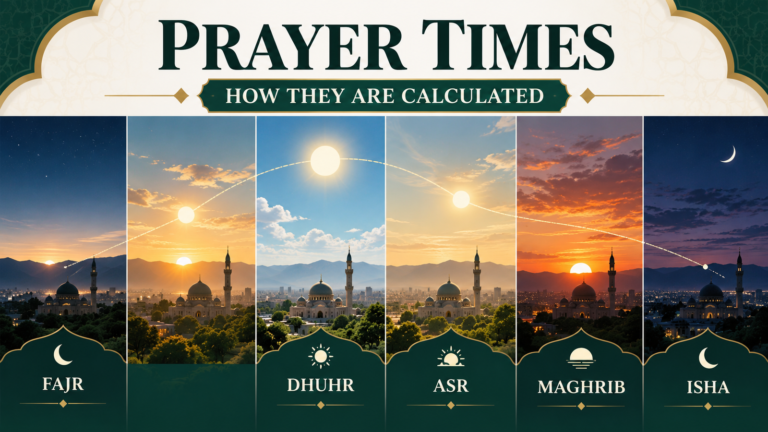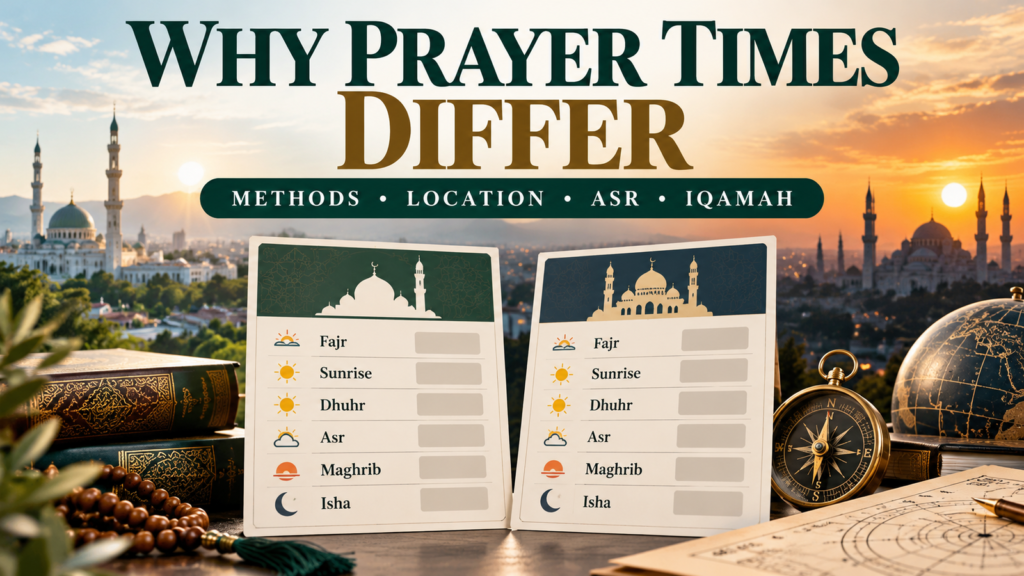
Two prayer-time websites can show different times for the same city without either necessarily having a software error. Differences may come from the chosen Fajr/Isha twilight convention, the Asr shadow method, city coordinates, rounding, daylight-saving conversion or a mosque’s local timetable. A helpful website should reveal these settings instead of merely publishing a time with no explanation.
Five major reasons prayer times disagree
| Cause | Likely effect | What to check |
|---|---|---|
| Twilight angle | Different Fajr or Isha start | Selected ISNA, MWL, Karachi, Egyptian or other method |
| Asr shadow convention | Standard Asr earlier than Hanafi Asr | Asr setting independent of twilight method |
| Location coordinates | Small to meaningful local differences | Actual city latitude/longitude and elevation assumptions |
| Clock and timezone rules | Potential one-hour display error at DST boundaries | IANA timezone and date-specific DST behavior |
| Adjustments and purpose | A few minutes or entirely different congregation time | Minute offsets, rounding, Adhan vs mosque Iqamah |
1. Fajr and Isha use different twilight conventions
The Qur’an and Hadith describe natural dawn and twilight events. Modern calendar makers estimate when these occur using solar astronomy. The PrayTimes calculation guide documents recognized Fajr/Isha settings including ISNA (15°/15°), Muslim World League (18°/17°), Karachi (18°/18°) and Egyptian (19.5°/17.5°).
The values are not equivalent. A larger solar depression angle generally selects an earlier morning event for Fajr and a later evening event for Isha when those events occur normally. This means the interval can differ systematically even for the same coordinates and date.
The Fiqh Council of North America suggests 15° for Fajr and Isha in the United States and 13° in Canada. This is an organizational recommendation, not a declaration that every other recognized convention is baseless.
2. Standard and Hanafi Asr are different choices
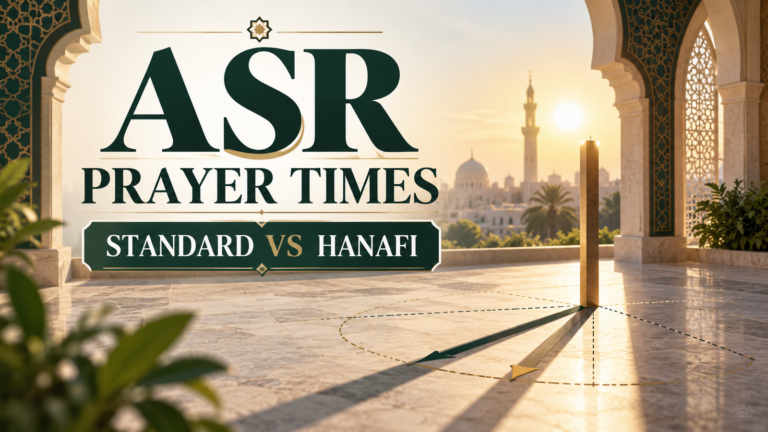
Another frequent source of confusion is the afternoon prayer. Standard and Hanafi Asr use different shadow-length thresholds. That distinction is independent of the Fajr/Isha angle. The Asr comparison guide explains the relevant Hadith evidence and a worked shadow example.
When comparing apps, confirm both the named calculation method and the selected Asr convention. Two apps can say “North America” yet show different Asr if one is configured for Hanafi and the other for Standard.
3. Nearby cities do not share exactly the same solar events
The Sun’s apparent timing depends on latitude and longitude. A large metro area may contain several municipalities with slightly different coordinates. Some tools use a city center; others use a mosque’s precise address or manually adjusted coordinate. Elevation and the visible local horizon can further affect observed sunrise or sunset, especially in mountainous terrain.
Published timetables usually use standardized refraction assumptions rather than weather-by-weather observation. A small mismatch does not establish which schedule is correct without checking the actual parameters.
4. Daylight-saving time can create an hour difference
Cities such as Boston and Lorton use America/New_York, which switches between civil time offsets during the year. Karachi uses Asia/Karachi and does not follow the same U.S. schedule. A prayer website must use the correct local date and time-zone rules for each stored timestamp.
A sudden one-hour disagreement around a DST transition is a strong reason to check the city’s time zone, cached page and device settings. It is not evidence that the Sun abruptly changed its behavior by an hour.
5. Prayer start, Adhan and Iqamah are not always the same display
A calculated prayer timetable generally gives astronomical prayer start times. A mosque may publish the beginning time, a chosen Adhan time, and a later congregational Iqamah time. Comparing a mosque Iqamah value with an app’s computed starting time will produce an apparent disagreement even if both are working as intended.
Apps may also apply small documented minute adjustments to satisfy local policy or operational choices. Those adjustments should be visible where possible.
How to compare two timetables fairly
- Check both show the same city or mosque location, including state and country.
- Match the same Gregorian local date and time-zone setting.
- Check the Fajr/Isha method and Asr school independently.
- Ask whether either schedule applies minute adjustments, different rounding or mosque-specific Iqamah.
- Compare individual events—not just whether one timetable is “earlier.”
- Where an important discrepancy remains, refer to a trustworthy local religious authority or the timetable publisher.
What our website displays
Islamic Utilities Core shows its chosen calculation method and Asr convention alongside supported city schedules. For fasting, the calculated Sehri boundary follows Fajr and Iftar follows the explicit sunset timestamp. That consistency helps readers understand where values come from, without claiming that all recognized methods must produce identical times.
Use the Prayer Times hub for available cities and the calculation explainer for the underlying solar events.
Frequently asked questions
Which prayer-time calculation method is best?
The choice depends on accepted local guidance, jurisdiction and the method used by the community or religious authority you follow. A transparent publisher states the method rather than promising one universal answer.
Why does Isha differ but Maghrib match?
Maghrib commonly uses sunset, while Isha depends on the end of twilight or a selected interval. Two apps can agree on sunset and disagree on Isha.
Why does my mosque show a later Asr time?
It may use Hanafi Asr or the displayed value may be the congregation’s Iqamah time. Confirm which before comparing.