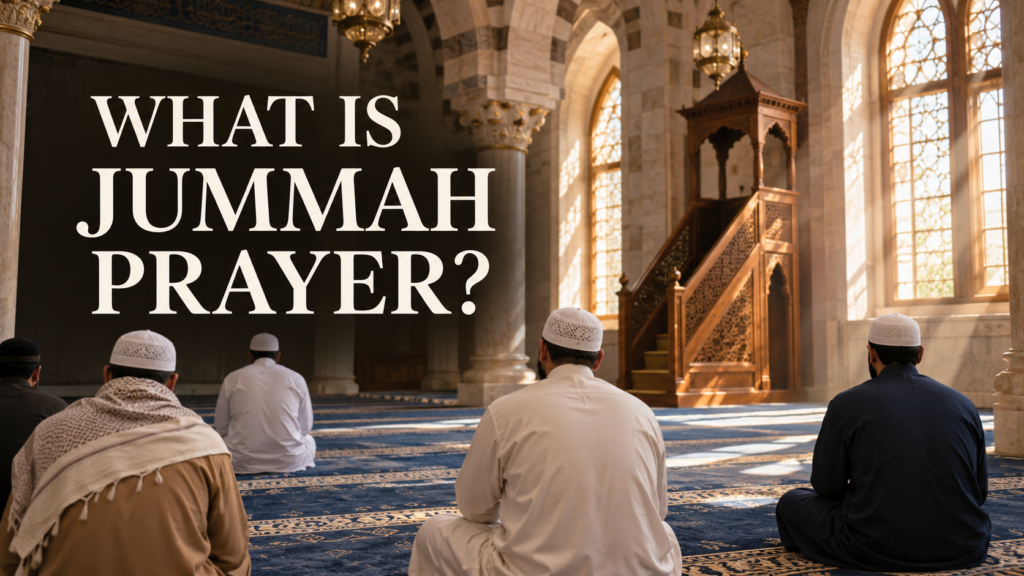
Quick answer: Jummah (also written Jumu’ah, Juma, or Jumma) is the congregational Friday prayer in Islam. It consists of a Friday sermon, called the khutbah, followed by two obligatory rak’ahs prayed behind an imam. For Muslims required to attend, a valid Jummah prayer replaces the regular four-rak’ah Dhuhr prayer on Friday.
What Is Jummah Prayer in Islam?
Jummah prayer, known in Arabic as Salat al-Jumu’ah (صلاة الجمعة), is the weekly congregational prayer performed on Friday.
The word Jumu’ah is associated with gathering or assembling. This reflects one of the prayer’s defining features: Muslims come together to worship Allah, listen to the Friday sermon, and strengthen their connection with their community.
Unlike the regular Dhuhr prayer, Jummah includes a formal khutbah delivered before the congregational prayer.
Essential facts about Jummah:
- Day: Friday.
- Prayer period: Generally during the Dhuhr prayer period, subject to differences in Islamic jurisprudence.
- Obligatory rak’ahs: Two.
- Khutbah: Delivered before the prayer.
- Congregation: Performed collectively under an imam.
- Religious status: Obligatory for eligible Muslims under established Sunni jurisprudence.
Jummah is therefore not simply a shorter version of Dhuhr. It has its own religious significance, conditions, and communal purpose.
What Does the Qur’an Say About Jummah Prayer?
The importance of Friday prayer is established directly in the Qur’an, particularly in Surah Al-Jumu’ah, Chapter 62, verses 9 and 10.
Surah Al-Jumu’ah, Verse 9
The Qur’an instructs believers that when the call to Friday prayer is made, they should proceed to the remembrance of Allah and leave their trading activities.
Reference: Surah Al-Jumu’ah 62:9 — Read the Arabic text and translations.
This verse establishes the importance of responding to the Friday call to worship instead of allowing ordinary commercial activity to take priority.
Surah Al-Jumu’ah, Verse 10
The following verse explains that after the prayer has concluded, believers may disperse and seek Allah’s bounty while continuing to remember Him.
Reference: Surah Al-Jumu’ah 62:10.
Together, these verses show a balance between religious responsibilities and everyday life. Muslims pause their ordinary activities for Friday worship and then return to their responsibilities.
Why Is Jummah Prayer Important?
Jummah holds a special position in Islam because it combines worship, religious instruction, and community participation.
The Friday gathering encourages Muslims to reflect on their relationship with Allah, listen to Islamic reminders, and renew their commitment to good conduct.
The importance of Jummah is further explained through several authentic narrations from Prophet Muhammad (peace be upon him).
1. Friday Prayer Is an Opportunity for Forgiveness
In Sahih Muslim 233a, the Prophet Muhammad (peace be upon him) explained that the five daily prayers and the period between one Friday prayer and the next can serve as expiation for sins, provided major sins are avoided.
Authentic Hadith: Sahih Muslim 233a.
This narration highlights the spiritual benefits of regular worship. It should not be misunderstood as permission to commit wrongdoing without sincere repentance.
2. Arriving Early for Jummah Has Special Merit
Sahih al-Bukhari 929 describes angels recording people who arrive at the mosque for Friday prayer in the order of their arrival.
The narration emphasizes the merit of attending early and explains that, when the imam begins the khutbah, the angels turn their attention to the sermon.
Authentic Hadith: Sahih al-Bukhari 929.
The practical lesson is to prepare in advance and arrive with enough time to participate attentively.
3. Neglecting Jummah Without a Valid Excuse Is Serious
In Sahih Muslim 865, the Prophet Muhammad (peace be upon him) warned against repeatedly neglecting Friday prayer.
Authentic Hadith: Sahih Muslim 865.
The warning concerns neglect of a religious duty. It does not mean that someone who is ill, traveling, or otherwise legitimately excused is blameworthy for being unable to attend.
4. Friday Is a Special Time for Supplication
Sahih al-Bukhari 935 describes a special period on Friday associated with the acceptance of supplication.
Authentic Hadith: Sahih al-Bukhari 935.
Scholars have discussed different interpretations of when this period occurs. Muslims are encouraged to remember Allah and make sincere du’a throughout Friday.
Who Is Required to Pray Jummah?
Under mainstream Sunni Islamic jurisprudence, Jummah is generally obligatory for adult, resident Muslim men who are able to attend and have no valid religious excuse.
The exemptions discussed in Islamic teachings include women, children, sick people, and travelers under the relevant legal conditions.
Sunan Abi Dawud 1067 mentions several categories exempted from the congregational Friday obligation.
Hadith reference: Sunan Abi Dawud 1067.
Can Women Attend Jummah Prayer?
Yes. In mainstream Sunni jurisprudence, women are generally not obligated to attend Jummah, but this exemption does not itself prohibit their attendance.
Sahih Muslim 442a records the Prophet’s instruction not to prevent women from attending mosques.
Reference: Sahih Muslim 442a.
A woman who participates in a valid Jummah congregation performs its two obligatory rak’ahs instead of the regular Dhuhr prayer.
If she does not attend Jummah, she ordinarily performs the four-rak’ah Dhuhr prayer.
Specific attendance arrangements and religious rulings may vary by community and Islamic legal tradition.
How Many Rak’ahs Are in Jummah Prayer?
The obligatory congregational Jummah prayer consists of two fard rak’ahs, performed after the khutbah.
However, Muslims may also perform additional recommended or Sunnah prayers before or after Jummah, according to their Islamic legal school.
For example:
- Two rak’ahs: The obligatory Friday congregational prayer.
- Additional prayers: Recommended prayers associated with Friday, whose details differ between legal schools.
Sahih Muslim 881a contains a narration concerning four rak’ahs after Jummah, while Sahih Muslim 882a describes two rak’ahs offered at home after Friday prayer.
References: Sahih Muslim 881a and Sahih Muslim 882a.
This is why different mosques or communities may teach different arrangements of recommended rak’ahs.
The essential distinction is that the obligatory Jummah congregation itself is two rak’ahs.
How to Pray Jummah: Step-by-Step Guide
If you are attending Friday prayer for the first time, the following overview explains the usual sequence.
Step 1: Check the Local Jummah Prayer Time
Find out when your mosque begins its Friday khutbah and congregation.
Jummah times are set by individual mosques. The time Dhuhr begins is not necessarily the same as the time the imam starts the khutbah or the prayer.
Our Jummah Prayer Time guide explains this difference and helps visitors find available city-specific information.
Step 2: Prepare for Friday Prayer
Make wudu, wear clean and suitable clothing, and prepare to attend the mosque.
Friday ghusl (bathing) is especially emphasized in authentic Hadith.
Sahih al-Bukhari 879 contains emphatic instructions concerning Friday bathing, and Sahih Muslim 846b mentions bathing, the siwak, and perfume.
References: Sahih al-Bukhari 879 and Sahih Muslim 846b.
Scholars differ over whether Friday ghusl is strictly obligatory in every case or a strongly emphasized Sunnah. Following the guidance of a qualified scholar from your legal school can clarify the ruling.
Step 3: Arrive Before the Khutbah
Try to reach the mosque before the imam begins the sermon.
Arriving early allows time to settle, find an appropriate prayer space, and prepare to listen without disturbing others.
Step 4: Listen to the Friday Khutbah
The imam delivers a sermon in two parts, with a brief sitting between them.
This practice is recorded in Sahih al-Bukhari 928.
During the khutbah, worshippers should listen attentively and avoid unnecessary conversation.
In Sahih Muslim 851a, the Prophet Muhammad (peace be upon him) even cautioned against speaking to tell another worshipper to be quiet while the imam is delivering the sermon.
Reference: Sahih Muslim 851a.
Step 5: Perform the Two Obligatory Rak’ahs
After the khutbah, the congregation stands to perform two rak’ahs behind the imam.
Follow the imam through the standing, recitation, bowing, prostrations, and concluding salam.
These two rak’ahs constitute the obligatory Jummah congregational prayer.
Step 6: Perform Any Recommended Prayers
After the congregation, you may perform the recommended prayers observed according to your legal school.
Some narrations describe two rak’ahs after Jummah, while others mention four. Ask your mosque’s imam if you are uncertain about the practice followed in your community.
What Is the Difference Between Jummah and Dhuhr Prayer?
Although Jummah generally takes place during the Dhuhr period, they are not identical prayers.
| Feature | Jummah Prayer | Dhuhr Prayer |
|---|---|---|
| Day | Friday | Every day |
| Obligatory rak’ahs | Two | Four |
| Khutbah | Part of Friday congregation | Not required |
| Congregation | Required under its conditions | Individual or congregational, subject to applicable rulings |
| Prayer timing | Scheduled by the mosque within the applicable prayer period | Begins according to the prayer-time calculation |
If a person validly performs Jummah, they generally do not need to perform the regular Dhuhr obligatory prayer again for that Friday.
What Time Does Jummah Prayer Start?
There is no single Jummah congregation time for an entire city.
Although Friday prayer is associated with the Dhuhr prayer period, the exact khutbah and congregational prayer times are determined by the mosque.
For example, one mosque may begin its khutbah shortly before 1:00 PM, while another may arrange its congregation later.
Some large mosques offer more than one Friday congregation to accommodate their communities.
Before attending, check:
- The mosque’s official Friday schedule.
- The khutbah starting time.
- The actual congregational prayer or iqamah time, where separately published.
- Any special announcements or schedule changes.
Looking for Friday prayer times in Chicago? Visit our Chicago Jummah Prayer Finder to see available mosque-published Friday schedules and official source links.
For an explanation of astronomical prayer calculations, see How Islamic Prayer Times Are Calculated.
What Happens If You Miss Jummah Prayer?
If someone misses the Friday congregation entirely, they ordinarily perform the four-rak’ah Dhuhr prayer instead of attempting a private two-rak’ah Jummah.
Egypt’s Dar al-Ifta explains this distinction in its guidance on making up a missed Friday prayer.
Scholarly reference: Dar al-Ifta — Manner of Making Up the Missed Friday Prayer.
If you arrive after the congregation has started but before it finishes, the rules for whether you have caught Jummah can vary between Islamic legal schools.
In that situation, consult the imam or a qualified scholar rather than assuming every late arrival follows the same ruling.
How to Prepare for Jummah Every Friday
Friday preparation does not need to be complicated. The goal is to attend worship respectfully, calmly, and with sincere attention.
- Check your mosque’s schedule: Confirm the khutbah and congregation times before leaving.
- Observe cleanliness: Make wudu and follow the Friday bathing guidance of your legal school.
- Dress appropriately: Wear clean clothing suitable for prayer.
- Leave early: Allow time for travel and finding a place in the mosque.
- Avoid distractions: Silence your phone before the khutbah.
- Listen attentively: Give the sermon your full attention.
- Make du’a: Remember Allah and ask for what is good.
- Continue good conduct: Carry the lessons of Friday worship into the rest of the week.
Frequently Asked Questions About Jummah Prayer
Is Jummah prayer obligatory?
Under mainstream Sunni jurisprudence, Jummah is obligatory for eligible adult, resident Muslim men who can attend and have no valid excuse. Other Islamic legal traditions may specify different conditions.
How many rak’ahs are in Jummah prayer?
The obligatory Friday congregation consists of two rak’ahs following the khutbah. Additional recommended prayers are separate.
Can women pray Jummah?
Yes. Women may participate in a valid Jummah congregation. In mainstream Sunni jurisprudence, attendance is generally not obligatory for them, and those who do not attend ordinarily pray Dhuhr.
Can Jummah prayer be performed alone at home?
Jummah is a congregational act of worship with specific conditions. Someone who cannot attend a valid Jummah congregation ordinarily performs Dhuhr instead. Establishing a Friday congregation is subject to additional legal requirements.
Is Jummah the same as Friday prayer?
Yes. Jummah, Jumu’ah, and Friday prayer commonly refer to the same weekly congregational worship in Islam.
Do I need to pray Dhuhr after Jummah?
Generally, no. Properly performing a valid Jummah prayer fulfills the corresponding Dhuhr obligation for that Friday.
What if I arrive after the khutbah starts?
Enter the mosque respectfully and follow the applicable guidance for joining the service. Some details, including voluntary prayers and catching the congregation late, differ among schools of Islamic jurisprudence.
Why do Jummah times vary between mosques?
The Dhuhr prayer period is related to the Sun’s position, but mosques schedule their own Friday khutbah and congregational prayer sessions. That is why nearby mosques may publish different Jummah times.
What is the meaning of Jummah Mubarak?
Jummah Mubarak is an Arabic-based greeting commonly understood as wishing someone a blessed Friday. It is a cultural and religious greeting, not a separate Friday prayer.
Final Thoughts: Why Jummah Matters Beyond Friday
Jummah prayer is an important part of Muslim religious and community life. It brings together the Qur’anic command to attend Friday worship, the Prophet’s guidance on preparation and attentiveness, and the experience of praying collectively.
Understanding Jummah means more than learning its two obligatory rak’ahs. It also means knowing why the khutbah matters, who is required to attend, how to prepare, and why local mosque schedules must be checked.
Whether you are attending a familiar mosque or visiting a new city, preparation helps you make the most of Friday worship.
Find Friday prayer schedules: Visit our Jummah Prayer Time hub to explore our available mosque timetable resources.
Qur’an, Hadith, and Scholarly References
This guide is supported by primary Islamic texts and established scholarly explanations. The following links allow readers to examine the original references and their translations.
- Qur’an 62:9 — The call to Friday prayer.
- Qur’an 62:10 — Activities after Friday prayer.
- Sunan Abi Dawud 1067 — Friday prayer obligation and exemptions.
- Sahih al-Bukhari 879 — Friday bathing.
- Sahih al-Bukhari 928 — The two khutbahs.
- Sahih al-Bukhari 929 — Virtue of arriving early.
- Sahih al-Bukhari 935 — Supplication on Friday.
- Sahih Muslim 233a — Spiritual benefits of prayer.
- Sahih Muslim 442a — Women attending mosques.
- Sahih Muslim 846b — Friday cleanliness and preparation.
- Sahih Muslim 851a — Listening to the khutbah.
- Sahih Muslim 865 — Warning against neglecting Jummah.
- Sahih Muslim 881a and 882a — Prayer after Jummah.
- Egypt’s Dar al-Ifta — Ruling on missed Friday prayer.
Editorial note: This article is an educational overview drawing primarily on the Qur’an, Hadith, and mainstream Sunni jurisprudence. Some rulings differ across Islamic legal schools. For individual religious questions, consult a qualified scholar from your tradition.